Crawl Space Water Removal Nashville, From Standing Water to Dry Joists
Most Nashville homes sit over a vented crawl space, and most crawl spaces collect water at some point: a hard rain on clay soil, a burst line under the house, a lot that drains the wrong way. Crawl space water removal Nashville homeowners need is the unglamorous sequence of getting that water out, drying the wood it has been soaking, and fixing the path it took in. This page walks through why it collects, what it does while it sits, and how this service connects you with independent local providers across Davidson County.
- Pumping from under the house
- Joist and subfloor moisture readings
- Encapsulation explained, not pushed
- Independent local providers
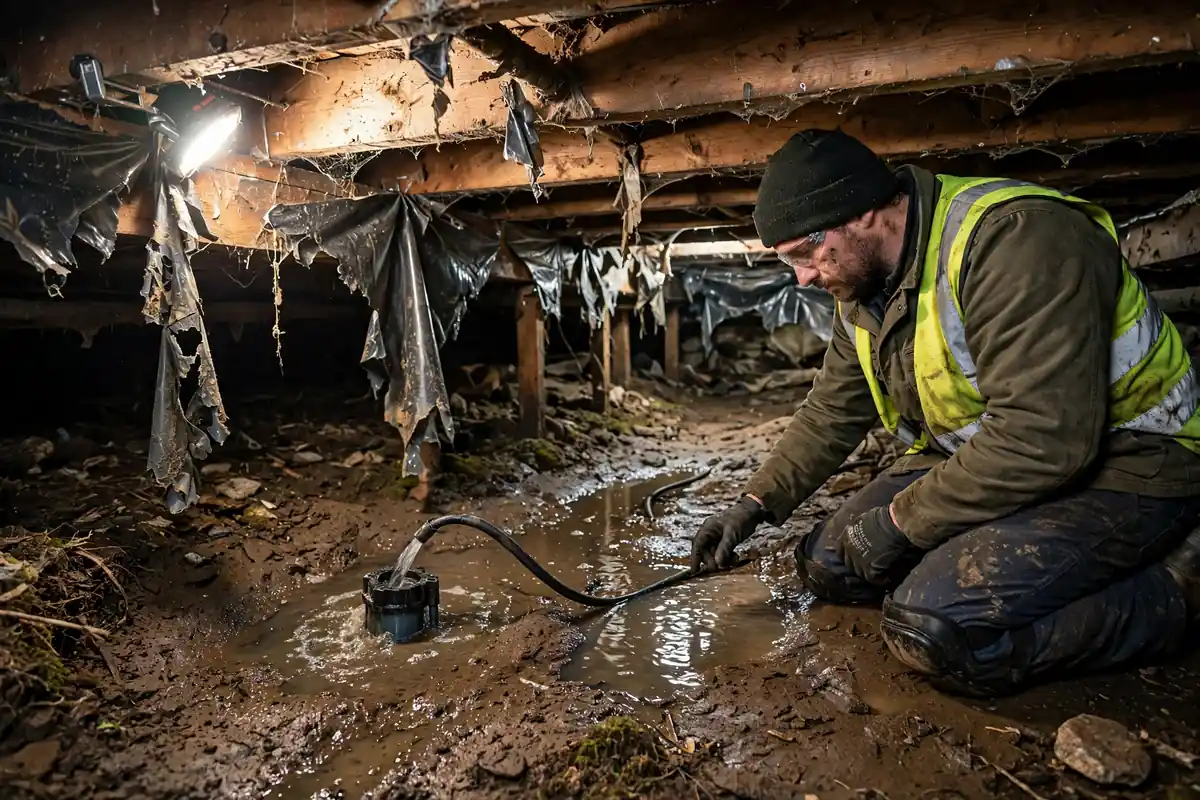
Crawl space water removal Nashville: pump, then dry the wood
Crawl space water removal in Nashville means pumping the standing water out, extracting what the soil and materials hold, then drying the joists and subfloor with equipment placed under the house until moisture readings hold at dry levels. The water is the fast part. The wood decides the schedule, and the entry path decides whether the job stays done.
Water in crawl space Nashville homes is usually discovered late: by a plumber on another job, a home inspector during a sale, or a homeowner who finally looks through the access door after a wet spring. By then the visible water is only part of the picture. The wood above it has been drinking from the damp air and the wet soil for as long as the water has sat there, which is why this service treats the pumping as the start of the work and the moisture readings as the end of it.
Clay soil, vented crawls and water with nowhere to go
Start with the soil. Tennessee clay drains slowly, and after a hard rain the ground around a foundation stays saturated for days. A crawl space is a shallow bowl dug into that clay, and water follows the path of least resistance into it: through the access side, at the low corner, along the foundation wall. With about 49 inches of rain a year, a lot that drains even slightly toward the house will deliver water under it, storm after storm.
The building details add their share. Vented crawl spaces, the standard under the postwar ranches of Madison, Donelson and Antioch, were designed for an earlier idea of airflow and do nothing to keep storm water out. Downspouts that end at the foundation pour roof water exactly where it does the most harm. Low lots along the Mill Creek corridor and the flat ground in parts of Hermitage and Bellevue hold standing water under house after house on the same street; the standing water under house Nashville inspectors photograph in spring is usually a street pattern, not one careless owner.
- Clay that will not drain. Saturated clay holds water against and under the foundation for days after rain stops, feeding the crawl long after the storm.
- Grading toward the house. Settled soil and landscaping beds often slope the last few feet the wrong way, aiming the lot's runoff at the foundation.
- Downspouts at the wall. A roof sheds thousands of gallons in a storm. Where the downspouts end decides whether that water lands in the yard or under the house.
- Low ground and creek lots. Mill Creek corridor lots and other low ground take both runoff and a rising water table, the two sources that arrive together.
- Nashville
- Madison
- Donelson
- Antioch
- Bellevue
- East Nashville
- Hermitage
- Brentwood
- Goodlettsville
- Hendersonville
- Mount Juliet
- Smyrna
- La Vergne
- Franklin
- Berry Hill
What standing water does to the house above it
Standing water under a house is not idle. The subfloor and the ends of the floor joists wick moisture upward continuously, and wood that stays above the normal dry range long enough begins to soften and, in time, decay. Insulation batts between the joists drink the damp air, grow heavy, sag away from the subfloor they were insulating, and stop doing their job even after they eventually dry. Ductwork running through the crawl takes water at its joints and rusts at its seams, and a duct lying in standing water is a duct being replaced. Standing water also creates the damp, still conditions that mold needs, which is one more reason a crawl space is dried on readings rather than left to dry on its own. None of this happens in a day. All of it happens in a season, quietly, under a house whose floors still feel solid.
The crawl space water cleanup Nashville providers price is therefore two jobs wearing one name: removing today's water, and reversing what the water has already done to the wood, insulation and ducts above it. A quote that covers only the pumping is a quote for the visible half.
Access and inspect
The space is entered safely, the water's entry point is found and photographed, and joist and subfloor moisture is metered before any equipment moves in.
Pump the standing water
Submersible pumps clear the pooled water, including the low corners where it collects deepest, and discharge it clear of the foundation.
Extract and clear
Remaining water is extracted from soil and materials, debris and collapsed insulation come out, and damaged duct sections are noted for repair.
Dry under the house
Crawl space drying Nashville work runs on equipment placed under the house: air movers across the joists and dehumidification sized for a low, vented space.
Read the wood
Moisture readings on joists and subfloor, taken at the far corners and not only at the access door, confirm the structure is back in the dry range.
Close the entry path
The scope ends with the source addressed or named: a pipe repaired, a downspout extended, a drainage fix recommended in writing.
The vapor barrier question, answered straight
Most Nashville crawl spaces have some kind of plastic ground cover, and a water event is hard on it: pumping and foot traffic tear it, silt buries it, and standing water floats it out of place. A barrier that survives intact still does its job, slowing the ground moisture that rises into the crawl between events. A barrier that is torn, displaced or missing in sections leaves bare clay exposed, and bare clay evaporates water into the crawl air every day of the year, quietly keeping joist moisture higher than it should be.
Replacing a damaged barrier belongs in the scope when the old one is genuinely compromised, laid over clean, dry soil after the readings confirm the space is dry. It does not belong in the scope as a reflex add-on over wet ground, where new plastic traps silt and water beneath it. The order is the whole point: dry first, barrier second.
- Barrier intact. If the ground cover survived in place and the soil under it dries on readings, it stays. No replacement needed.
- Barrier torn or displaced. Sections floated, ripped during pumping, or buried in silt are replaced once the soil is dry, so the new cover sits on clean ground.
- Barrier missing. Many older homes never had full coverage. Bare clay is a permanent moisture source, and covering it is a legitimate part of finishing the job.
- Barrier is not drainage. Plastic slows rising damp. It does not stop liquid water arriving from grading or downspouts, and should never be sold as if it does.
Encapsulation is a decision. Drainage is a fix.
Encapsulation, as information
Encapsulation seals the crawl space completely: vents closed, a heavy liner run over the floor and up the walls, and the air inside conditioned or dehumidified. Done well, it is a genuine long-term answer for a house whose crawl is damp every season. It is also a separate, larger project with its own price, and it is not part of removing today's standing water. The honest sequence is dry the space first, read the moisture across a season, and then decide with numbers whether the house is a one-event house or a chronic-moisture house. Any provider who quotes encapsulation before the crawl is dry is selling the second job before finishing the first.
Drainage, the recurrence fix
What stops the water coming back is mostly outside work. Grading that slopes away from the foundation for the first several feet. Downspout extensions that carry roof water well clear of the house. Gutters sized and cleared so they stop overflowing at the wall in heavy rain. On low lots, an interior perimeter drain with a sump gives groundwater a managed exit instead of a standing pool. These are the fixes that change what the next storm does to your crawl space, and a drying scope should name which of them your lot needs.
General patterns, not advice about your own cover. Insurance treats a burst line under the house and groundwater in the crawl very differently; the FAQ below covers the split. For the cost side of crawl space work, the published ranges and quote-reading method are on our restoration cost guide, and the full service starts from the water damage restoration Nashville homepage. When the water under the house arrived as storm flooding across the yard, the flood cleanup page covers that event instead.
Common questions about water under the house
How long can water sit under a house before it does damage?
Damage starts on the first day and compounds. Subfloor plywood and joist ends begin wicking water immediately, batt insulation sags and loses its value as it saturates, and ductwork lying in standing water takes damage at its seams and insulation wrap. Within days the wood moisture content climbs past the level where decay organisms thrive. A crawl space found wet within a day or two of a storm is usually a pumping and drying job. One that has sat for a season can involve subfloor repair and insulation replacement. The water is patient, which is why the response should not be.
Is it safe to go into the crawl space myself?
Usually not the best plan, and sometimes not a safe one. Crawl spaces concentrate hazards in a low, dark space: live wiring and junction boxes at the same height as standing water, sharp debris and nails in the soil, snakes and animals in the warm months, and air that has been sitting over wet ground. If you go in at all, go in dry conditions, in daylight, with a light, gloves and boots, tell someone you are under there, and never enter standing water where any electrical line or HVAC equipment sits. The inspection that matters, with meters and a pump plan, is the provider's job.
Does homeowners insurance cover water in the crawl space?
It depends on how the water got there, and the two common paths land very differently. Water from a burst pipe under the house is a sudden internal event and is usually covered, with the crawl space drying and damage inside the claim. Water that seeped in from saturated ground, a high water table or poor drainage is treated as groundwater and maintenance, and is usually excluded. Rising water from a storm belongs to flood cover, which is a separate policy. Documenting the entry point with photographs is what lets the claim be argued on the right facts.
How long does crawl space drying take?
Most crawl spaces dry in three to five days after pumping, with equipment running under the house and daily moisture readings on the joists and subfloor. Saturated insulation, a low crawl with poor air access, or a space that sat wet for weeks runs longer, and insulation that has collapsed usually comes out rather than drying. Drying is finished when wood moisture readings hold in the normal dry range, checked at the joist ends and subfloor rather than at the access door where the air moves best. A provider should be able to show you the numbers.
Do I need encapsulation after water is removed from my crawl space?
Not automatically, and be wary of anyone who quotes it before the space is dry. Encapsulation, sealing the vents and lining the floor and walls with a heavy barrier tied to conditioning or dehumidification, is a long-term moisture control system. It suits homes with recurring groundwater moisture and is a separate, larger decision with its own price. A crawl space that flooded once from a burst pipe and dries fully may need only its vapor barrier restored and the pipe fixed. A crawl space that is damp every spring is the honest encapsulation conversation, held after drying, with the moisture readings on the table.
What stops water coming back under the house?
The fixes are outside the crawl space more often than inside it. Grade the soil so the lot slopes away from the foundation instead of toward it. Extend downspouts so roof water lands well clear of the house instead of at the wall. Keep gutters from overflowing at the foundation line. On lots where groundwater itself is the problem, an interior perimeter drain and sump under the house gives the water somewhere to go. Inside, a sound vapor barrier slows ground moisture between events. A provider who dries the crawl and names which of these your lot needs has finished the job properly.
Standing water under the house is not a wait-and-see problem.
It is soaking the structure your floors stand on, a little more every day it sits. Get it pumped, get the wood read dry, and get the entry path named in writing. Reach out now and get connected with a local provider who does crawl space work across Davidson County.
Get Help Now