Emergency Water Damage Restoration Nashville, From First Call to Fully Dry
When a pipe bursts at night or a water heater lets go on a Sunday, emergency water damage restoration Nashville homeowners can rely on is less about slogans and more about order: make the area safe, stop the water, document the damage, then extract and dry before the loss grows. This page walks through that order, the checklist for the first minutes, and how this service connects you with independent local providers across Davidson County.
- Electrical safety before anything else
- Documented before cleanup starts
- Extraction and drying in one plan
- Independent local providers
Emergency water damage restoration Nashville: the order of response
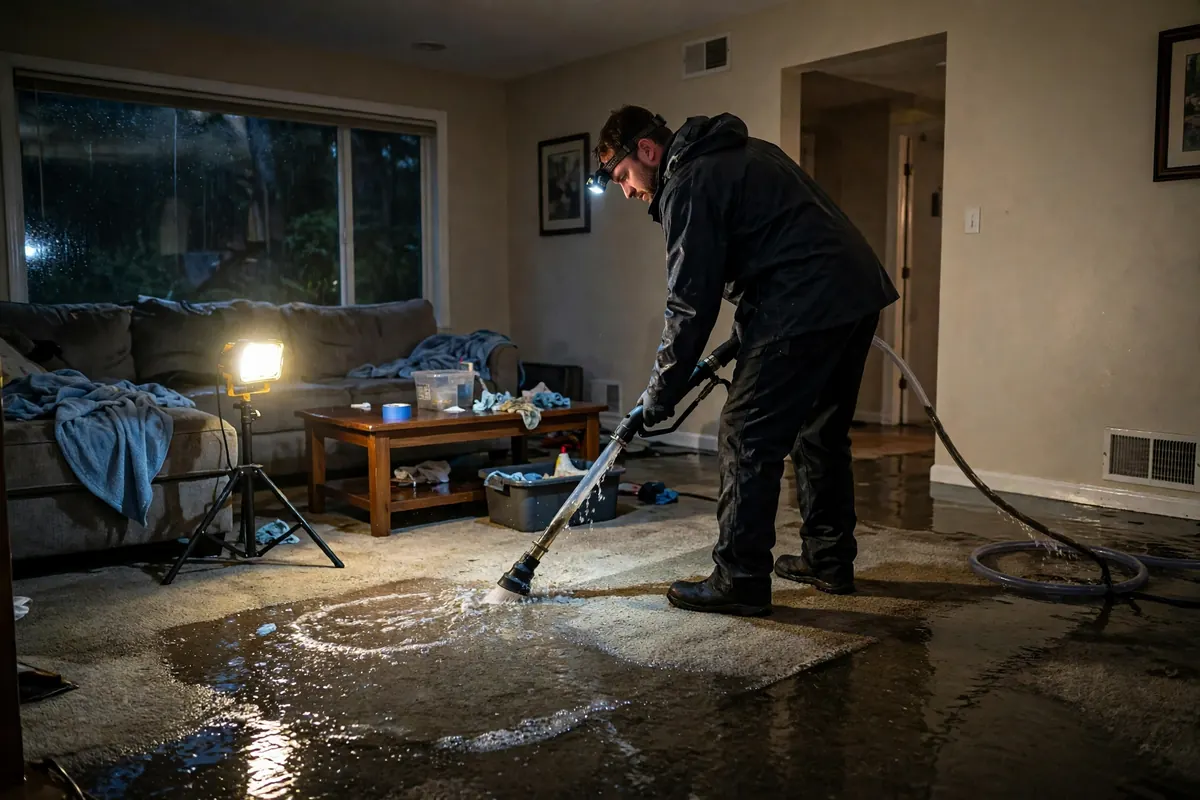
Emergency water damage restoration in Nashville starts with safety: power away from the water, the supply shut off at the main, and contents lifted clear. Then document everything for the claim, extract the standing water, and place drying equipment the same visit, because every hour of standing water deepens the damage.
The order matters because each step protects the next one. Extraction before the photographs weakens the insurance claim. Drying equipment placed before the meter readings is guesswork. Walls opened before the water is stopped just give the water new places to go. The sections below follow the sequence a good emergency crew works in, and what you can usefully do yourself in the first minutes, which is more than most homeowners expect.
What counts as a water emergency
A water emergency is any release of water that is still moving, still spreading, or sitting deep enough to keep soaking the structure. The common Nashville versions are a burst or frozen pipe, a water heater that fails and drains its tank across the floor, a washing machine or ice maker supply line that lets go, and storm water pushed into the home by a stalled system over the creek corridors. About 49 inches of rain a year on Tennessee clay means the ground gives storm water nowhere to go, and it finds the crawl space and the lowest door first.
One version of this list belongs on a different page. A sewage backup is an emergency too, but the water is contaminated and the rules change: protective equipment, disinfection and disposal all step up. Our sewage cleanup page covers that case. Everything else on this page assumes clean or lightly soiled water from a pipe, an appliance or the sky.
However the search was phrased, emergency water damage cleanup Nashville homeowners are looking for in that first hour is the same short list: stop it, record it, get it out, dry what is left. Some type emergency water removal Nashville into the same search box; it is the same job list, with the water coming out as the urgent middle step. The rest of this page is those four jobs in detail.
- Burst and leaking pipes. A supply pipe that splits or a joint that fails can put hundreds of gallons into walls and floors before anyone hears it. The damage map is usually wider than the wet patch you can see.
- Failed water heaters. A heater that rusts through drains its whole tank, and the supply keeps feeding it until the valve is closed. Garage and closet heaters are the classic Nashville version.
- Supply line breaks. The small lines to washers, ice makers, dishwashers and toilets fail quietly and run for hours, often overnight, which is why these losses are so often found at breakfast.
- Storm intrusion. Water through a roof leak, a window well or a crawl space during heavy rain, worst in the low ground along Mill Creek and Richland Creek and in homes that took water in May 2010.
Safety first, water off, contents up
Respect the electricity
If water is near outlets, appliances, a water heater or the breaker panel, stay out of it. Water and household current are the one part of this job that can hurt someone. When in doubt, keep people and pets clear and let the provider or an electrician make the call.
Stop the water
Close the fixture valve if the source is one appliance. Otherwise close the main shut-off. In Nashville homes the main valve usually hides in one of three places: in the crawl space near the front wall, on a garage or utility wall where the line enters, or in the meter box at the street, which needs a meter key or wrench.
Photograph everything
Before anything moves, walk every affected room with a phone camera. The next section is the full documentation checklist. It takes ten minutes and it is the backbone of the insurance claim.
Lift the contents
Get furniture legs onto foil or blocks, move rugs, boxes and electronics off wet floors, and carry documents, medicines and valuables to a dry room. Cardboard on a wet floor is a total loss within the hour.
Slow the spread
Towels rolled at door thresholds keep water out of dry rooms. A bucket under an active drip and a mop on hard floors are worth doing. Skip the wall demolition and the carpet tearing for now; documented damage is paid damage.
Make the call
Reach out for the emergency visit and call your insurer to open the claim. Between the two, the home should be safe, dry at the source, documented and defended against further spread, which is a strong first hour.
The documentation checklist, before cleanup starts
- Video walk-through of every affected room, starting at the source, before anything is moved.
- Close photographs of the failed pipe, valve or appliance, including any model and serial plate.
- The water line marked on walls with painter's tape, then photographed with something for scale.
- Photos of the crawl space and any room below the leak, not just the room where it started.
- An inventory list of damaged contents as items come out, with photographs of each item in place first.
- Receipts kept for emergency purchases, pumps, fans, hotel nights and meals out.
- The date and time the water was discovered and the date and time it was stopped, written down.
Extraction, readings and drying equipment
When the provider arrives, the visit follows a pattern. The source is confirmed stopped, the electrical question is settled, and the home is walked with moisture meters, including walls and floors that look dry, because water travels along framing and under flooring well past the visible stain. Those readings set the scope. Then the standing water comes out: crews call this stage emergency water removal, and our water extraction and mitigation page covers the equipment and method in detail. Wet materials that cannot be saved are identified for removal, and drying equipment is placed the same visit, sized and positioned from the meter map rather than by habit.
The drying that follows is its own discipline, managed by daily readings until the structure reaches normal levels. It has its own page because homeowners ask about it more than any other stage: structural drying explains what the equipment does, how long it runs and how anyone knows the job is finished. On a well run emergency job the two stages are one plan, extraction handing straight into drying with no gap day in between.
Night and weekend reality
Water does not keep office hours, and neither does the damage. A pipe that lets go at midnight has soaked the subfloor by morning. This is why the trade works around the clock, and why the honest measure of a 24 hour service is not a badge on a website but the sequence on this page: a real first visit, extraction started, equipment placed, readings taken. Ask any provider what the first visit includes and judge the answer against that list. That is what 24 hour water damage restoration Nashville listings should be held to, whatever the clock says.
Where emergencies hit in Nashville
The pattern follows the housing. Postwar brick ranches in Madison, Donelson and Antioch put pipes and heaters over vented crawl spaces, so failures drain into the structure quietly. Bellevue and Hermitage take the creek and river side of storm nights. East Nashville's older homes pair aging supply lines with finished basements that hide a leak until it is a large one. The providers in this network work across 23 Davidson County ZIP codes.
- Nashville
- Madison
- Donelson
- Antioch
- Bellevue
- East Nashville
- Hermitage
- Brentwood
- Goodlettsville
- Hendersonville
- Mount Juliet
- Smyrna
- La Vergne
- Franklin
- Berry Hill
What not to do
- Do not enter standing water that is anywhere near outlets, appliances or the panel until the power question is settled.
- Do not point household fans at wet walls and call it drying. Fans move air; they do not remove moisture from inside a wall, and the readings will prove it later.
- Do not tear out drywall, carpet or cabinets before the damage is photographed and listed. Undocumented damage is the claim dispute nobody wins.
- Do not run a furnace or air handler with wet ductwork or a soaked filter; it spreads dirty air through the whole house.
- Do not wait for a weekday to deal with a weekend leak. The drying clock started when the water did.
Common questions in a water emergency
How fast should water extraction start after a burst pipe?
As soon as the water is stopped and the area is electrically safe, ideally the same day. Standing water keeps wicking into drywall, insulation and subfloor for as long as it sits, and every hour adds material to the removal list. The source repair and the safety checks come first, but extraction is not a tomorrow job. If a provider cannot start promptly, ask them plainly when they can, and keep working through the first-minutes checklist on this page in the meantime.
What should I do before help arrives?
Four things, in order. Keep power away from wet areas if there is any doubt about outlets or appliances. Stop the water at the main shut-off if the source is a pipe or appliance. Photograph and video every affected room before you move anything, because that record carries the insurance claim. Then lift contents off wet floors, get documents and medicines up high, and put towels at door thresholds to slow the spread. Skip tearing out walls or carpet until the damage is documented.
Will insurance cover an emergency water damage call?
Usually, when the cause is sudden and accidental: a burst pipe, a failed water heater, a supply line that lets go. That is exactly the class of loss homeowners policies are written for. Slow leaks that ran for months and rising flood water are the usual exclusions. Two habits protect the claim: report the loss promptly, and document the damage before cleanup changes it. Keep receipts for emergency work and any hotel or supplies, because mitigation spending is normally part of the claim file.
Can I stay in the house during an emergency cleanup?
In most plumbing emergencies, yes. The affected rooms are worked on while the rest of the house stays livable, and the main inconveniences are noise from drying equipment and losing the use of one bathroom or the kitchen for a few days. Staying somewhere else enters the picture when the water is contaminated, when the electrical system is compromised, or when the only bathroom is out of service. The first visit usually settles which case yours is.
What happens on the first visit?
The provider confirms the source is stopped, checks the affected areas are safe to work in, and walks the home with a moisture meter to map how far the water traveled, including inside walls and under floors. Then standing water is extracted, materials that cannot be saved are identified, and drying equipment is placed and sized to the readings. You should leave that visit with a written scope: what was found, what comes out, what dries in place, and how the drying will be checked day by day.
How long until the house is dry?
Two clocks run on every job. The drying clock is days: most structures dry in 3 to 5 days of equipment running, confirmed by moisture readings rather than by feel. The rebuild clock is weeks: drywall, flooring and paint go back after the readings say dry, and scheduling trades stretches that part out. Anyone who quotes one number for both is skipping the honest part. Ask for the drying estimate and the rebuild estimate as two separate answers.
The water is stopped. Now get it out.
You have done the first hour right: safe, documented, defended. The next hours decide how much of the house has to come out, so get the extraction and the meter readings started. The full service overview is on the water damage restoration Nashville homepage, and the cost side is set out in our restoration cost guide. Reach out now and get connected with a local provider.
Get Help Now