Structural Drying Nashville, Measured Dry, Not Guessed Dry
Getting the standing water out is only half the job. Structural drying Nashville homeowners need afterward is the slower, measured half: pulling the moisture that soaked into drywall, hardwood, concrete and framing back out again, and proving with daily meter readings that it is gone. This page explains how that stage works, what the equipment actually does, and how this service connects you with independent local providers across Davidson County.
- Moisture mapped before equipment is placed
- Daily readings, logged and shown to you
- Dry standard in numbers, not by feel
- Independent local providers
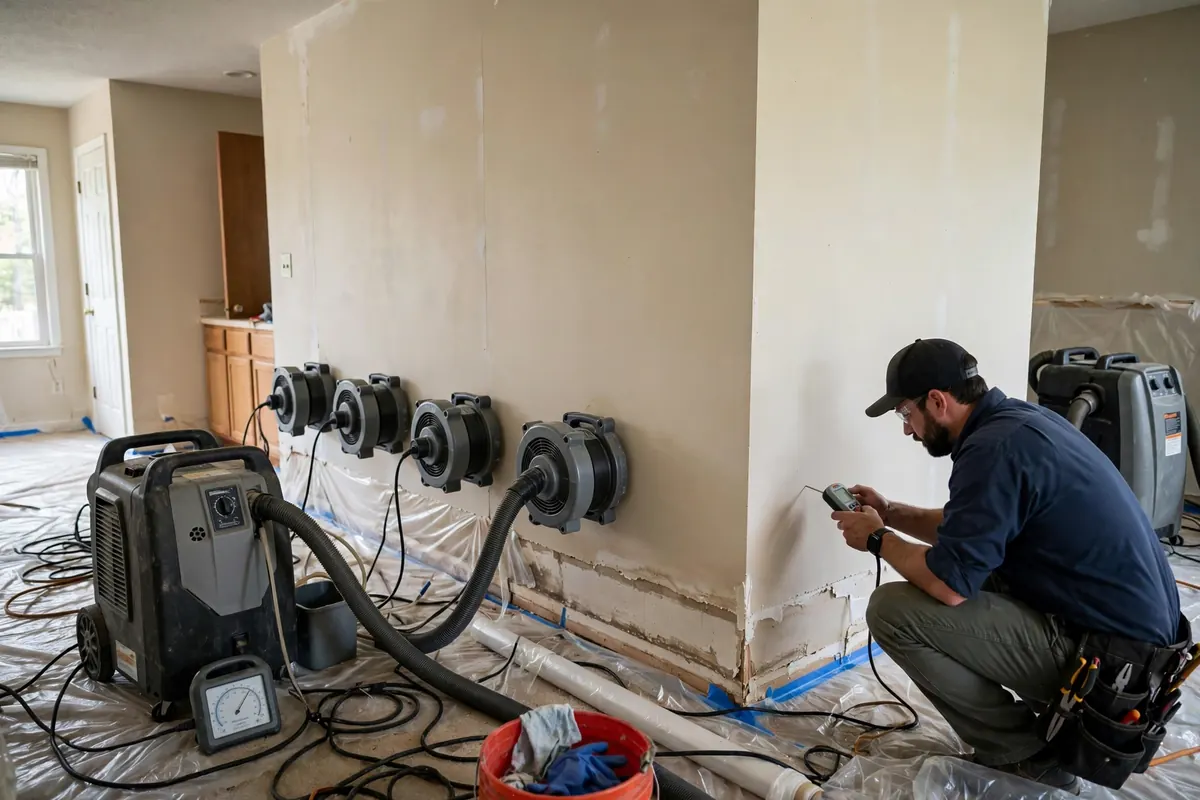
Structural drying Nashville: extraction ends, drying begins
Structural drying in Nashville is the stage after extraction: air movers and dehumidifiers pull moisture out of drywall, hardwood, concrete and framing while a technician maps moisture and takes daily readings. The job ends when readings on the same points first measured wet reach normal levels, and the numbers are documented.
The distinction sounds technical and is actually simple. Extraction removes liquid water you can see and pump. Drying removes the water you cannot see, the moisture that wicked into the materials themselves in the hours the liquid sat there. A room can look finished after extraction and still hold enough moisture in its walls and subfloor to warp flooring and feed hidden growth. Our water extraction and mitigation page covers the first stage; this page is the second, and on a well run job the second starts the same visit the first one ends. If the water is still arriving rather than already out, start with our emergency water damage restoration page instead.
Moisture mapping and daily readings
A proper structural drying job starts with a map. The technician works through the affected rooms with moisture meters, reading walls, floors and framing on a grid, and marks how far the moisture traveled, including into rooms that look untouched. Probes reach inside wall cavities, because the back of the drywall is where the water went and the face of the wall is the last place it shows. That map decides where equipment goes, how much of it, and what the dry target is for each material.
Then the job becomes a routine: the same points read again each day, the readings logged, equipment adjusted or moved as areas reach target. People searching for dehumidification services Nashville providers offer are really buying this routine, not the machines. The machines are rented metal. The readings are the work, and they are what separates a structure dried on evidence from one dried on a schedule.
- The wet map. Readings across every affected surface at the start, including wall cavities and the subfloor, drawn up before a single air mover is placed.
- The dry standard. Each material has a normal moisture level, checked against the same material in an unaffected room. That comparison, not a generic number, is the target.
- The daily log. The same points re-read daily and recorded. The log is your proof the job is done and the insurer's proof the equipment days were earned.
- The adjustment. Equipment is repositioned, added or removed as the readings move. A setup nobody checks for four days is not a drying plan.
What the machines in your house are doing
Air movers
Strong, low fans that push air across wet surfaces. Moving air lifts moisture out of the material and into the room air, the same physics as wind drying laundry, run at industrial volume. They do not remove moisture from the house; they hand it to the dehumidifiers. Air movers alone, without dehumidification, just move the water from the walls into the air and back again.
Dehumidifiers
The machines that actually take water out of the building, draining it to a sink or tub by the gallon. Refrigerant units, the common kind, pull room air over cold coils and condense the moisture out. Desiccant units use a moisture absorbing material and heat, and earn their place in cool spaces like crawl spaces and in winter jobs, where refrigerant units lose efficiency. Sizing is matched to the volume of water the map says is in the structure.
- Wall cavity drying. Small hoses push dry air into the space behind drywall through discreet holes, often at the baseboard line, so a wet wall can dry in place instead of being demolished.
- Hardwood floor systems. Mats and directed airflow pull moisture up through floor boards evenly, which is what gives cupped hardwood a chance to settle flat again.
- Containment and air filtration. Plastic barriers keep the drying zone tight and the rest of the house clean, and filtration units scrub dust and particles out of the work area air.
- Crawl space drying. Air movement and dehumidification under the house, where framing and subfloor dry slowly and the ground itself keeps feeding moisture upward.
How long each part of the house takes to dry
Drywall
The fastest common material when the water was clean and the response was quick. Wet drywall usually dries in place over 3 to 5 days with cavity air, provided the paper backing has not been soaked for days already.
Hardwood floors
The slow, valuable case. Boards cup as they take on water and need slow, even drying over a longer run to settle back. Rushed heat or uneven airflow locks the damage in.
Concrete
Slabs and block hold water deep and give it back slowly. A garage or basement slab can read wet long after the surface feels dry, and flooring laid over it too early fails.
Crawl space framing
Joists and subfloor over a vented Nashville crawl space dry at the pace of the air under the house. Expect the longer end of the range, with ground moisture working against the equipment the whole time.
Put together, most structures reach dry readings in 3 to 5 days, which is the range behind nearly every honest estimate for water damage drying Nashville homeowners are quoted. The exceptions run in both directions: a small clean water loss caught in the first hour can finish sooner, and a flooded crawl space under a Madison or Antioch ranch in a humid week can run past it. Tennessee clay and summer humidity are the reasons the range exists, and the readings, not the range, close the job.
When drying is not enough
Drying has limits, and a straight provider names them early. Some materials cannot be dried back to safe: insulation that has soaked and matted, particleboard that has swollen, carpet padding under contaminated water. Those come out, and drying handles what remains. Hidden cavities are the other limit. If readings inside a wall stay high while the face dries, the cavity gets opened rather than wished dry.
Water category sets the hardest limit. Clean supply water is a drying job. Water that carried soil, chemicals or sewage is a removal and disinfection job first, because drying contaminated material in place leaves the contamination in place. That case is covered on our sewage cleanup page. Knowing which case you have is a first visit question, and it changes the plan more than any equipment choice does.
Why household fans and open windows do not substitute
It is a fair question, because fans feel like drying. The problem is removal. A box fan moves moisture from the wall into the room air and leaves it there. Open windows in a Nashville summer trade indoor air for outdoor air that is carrying its own load of water, in a county that takes about 49 inches of rain a year and holds summer humidity for months. The structure equilibrates with the wet air instead of drying. Structural drying services exist to break that balance: capture the moisture, drain it out of the building, and prove the result with readings. When the job is done, the restoration cost guide explains how drying days appear in the overall price of a job.
Common questions about structural drying
How long does structural drying take?
Most Nashville homes dry in 3 to 5 days of equipment running. Drywall and carpet assemblies sit at the shorter end when the water was clean and the response was fast. Hardwood floors, concrete and crawl space framing run longer, and a structure that sat wet for days before the call starts behind. The calendar is an estimate, though. The job ends on readings: when the moisture levels on the mapped points reach normal, the equipment comes out, whether that is day three or day six.
How do you know when the structure is actually dry?
By numbers, not by touch. At the start of the job the technician maps moisture readings across walls, floors and framing, including points inside wall cavities. Each day the same points are read again and logged. Dry means those readings have reached the normal level for that material, roughly the level of the same material in an unaffected part of the house, and held there. A provider should be able to show you the log. A dry standard stated in readings is also what an insurer asks for when the file is reviewed.
Is the drying equipment loud, and does it make the house hot?
Air movers sound like strong box fans, several of them, running around the clock. Dehumidifiers add a low hum and give off warmth as they work, so the affected rooms will feel warmer than the rest of the house for a few days. Most households sleep through it once doors are closed, and the equipment is usually concentrated in the affected rooms rather than spread through the home. It is an inconvenience measured in days, and it is the trade for not opening walls that did not need opening.
Do I need to leave the house during structural drying?
Usually not. With clean water losses, families stay in the home while drying runs, working around the equipment and the noise. Leaving enters the picture when the water was contaminated, when large areas are being demolished, or when the only bathroom or the kitchen is inside the drying zone for days. The technician should tell you on the first visit which case yours is, and if a short stay elsewhere is part of the plan, that cost conversation belongs with your insurer from the start.
Does insurance pay for the days the drying equipment runs?
On a covered loss, drying is a standard part of the claim, billed by the day and the piece of equipment, and supported by the daily reading log. That documentation is why the numbers matter: an adjuster reviewing the file wants to see that each day of equipment was justified by readings that were still above normal. Drying that runs without a log, or equipment left running after the structure reached dry readings, is the part of a bill most likely to be questioned.
What happens if the walls are not dried properly?
The damage moves out of sight instead of going away. Wet drywall loses strength and sags, hardwood cups and buckles as it dries unevenly, and framing that stays damp is where mold takes hold in the weeks after the leak, quietly, inside the wall cavity. Odors follow. By the time any of it shows on the surface, the fix is demolition that proper drying would have avoided. This is the entire argument for measured drying: the cheap week is the one with the meters running.
A room that looks dry is not the same as a dry house.
The difference is a set of readings, taken daily, on the points that were wet. Get the map, the equipment and the log started together. The full service overview is on the water damage restoration Nashville homepage. Reach out now and get connected with a local provider who dries by the numbers.
Get Help Now